Translate, listen, and practice the dots and dashes.
LIVE TRANSLATION
International Morse uses a 1-unit dot, 3-unit dash; 1-unit gaps within a letter, 3 between letters, 7 between words.
11 chars
0 symbols
0 characters0 words0 symbols0s estimated
Reference · ITU-R M.1677-1
Morse Code chart
International letters and numerals. Select a cell to insert its signal.
Input · keyboard / touch
Morse key
Tap or hold a key; Space works too. A long press makes a dash.
Ready to key
Press Space for a dot; hold for a dash. Letter gaps are detected after 700 ms.
Training · local only
Practice Morse Code
Try a Morse quiz: hear it, see Morse and pick a letter, or type the code.
Ready?
Score 0Streak 0
Decode · browser audio
Audio input
Decode clean beeps at about 10–25 WPM in a quiet room. Noise, voices, and fast signals reduce accuracy; knock mode uses an amplitude threshold.
Microphone permission is requested only when you start. Clean beeps at 10–25 WPM in a quiet room work best.
No message leaves this device. Audio synthesis, decoding and preferences stay in your browser.
Before enabling screen flash
Flashing light may trigger seizures in people with photosensitive epilepsy. Keep it off if you are unsure. This feature only makes a subtle full-screen pulse in time with playback and is disabled by default.
This free online morse code translator converts text to morse code and back in real time. It works as an english to morse code translator and as a morse code to english decoder. Type in either box. The other box updates instantly, so there is nothing to submit.
Play the result as audible beeps and download it as mp3 or wav. If you prefer something visual, flash it as a blinking light. There are no ads. Everything runs in your browser, so it stays fast and private.
The guide below covers the basics, from reading dots and dashes to decoding audio. It also answers the questions people search for most often.
What is Morse code?
Morse code is a method of writing letters and numbers as short and long signals. Every letter is built from two signals only: dots and dashes. The signals travel equally well as sound or light, which is why the code outlived the telegraph wire.
Samuel Morse and Alfred Vail developed the system in the 1830s and 1840s for the electric telegraph. Vail did much of the practical work on the code table.
How to Translate Morse Code into English, Words and Numbers
Turning dots to text with the translator takes only four quick steps.
Paste your dots and dashes into the Morse box on the right.
Use one space between letters and a slash between words.
Read the English text that appears in the other box.
Fix anything highlighted in red, since the tool cannot convert those characters.
This morse code to text method works for words and numbers alike. Numbers use five signals each, so they are easy to spot. In digits 1 to 5 the number of dots equals the digit. From 6 to 9 the number of dashes is the digit minus five, and 0 is five dashes.
Decoding Morse code without spaces
Morse without spaces is ambiguous, because the same string can split in several ways. Three dots in a row could mean S, or EEE, or IE, or EI. The Guess spacing button picks the most likely reading, but check it yourself.
How to Translate Morse Code Audio?
Audio to text decoding comes down to measuring how long each beep lasts. Short beeps are dots. Long ones are dashes.
To use the tool, open the Listen tab and press the microphone button. Hold the phone close to the speaker and keep the room quiet. For live audio, the text appears in real time as the beeps arrive. You can also upload audio, such as a wav or mp3 recording, for sound to text decoding.
Knocking works too. Switch to knock mode for taps and clicks, because they have no steady pitch. Expect good results from clean beeps at 10 to 25 WPM. Static, voices or very fast sending will lower accuracy, and the text may need editing.
Decoding by hand means writing a dot for each short beep and a dash for each long beep. Leave a wider gap on the page wherever the silence stretches out for a moment.
How to Use the Morse Code Translator
Text to Morse code. Type or paste your message into the Text box and the Morse appears at once. Copy and paste the result into any message or document using the Copy button. Press Swap to flip the two boxes when you want to decode instead.
Sound. For text to morse code with sound, set speed in WPM and pitch in Hz, then press Play. Download the file as mp3 or wav if you want to keep it. The Reverse option flips the output order, which helps with puzzles.
Tap. Tap mode lets you send Morse by tapping, using the space bar, a click or a touch. A quick press records a dot, and holding it longer records a dash. Pause between letters and the tapper decodes each one for you. Mouse users get a clicker, and phone users get a large tap pad.
Light. Flash mode turns your whole screen into a blinking light. It works as a flashing light for silent signals and visual practice. Flashlight control on phones depends on the browser and may not be available.
Languages. Pick a language from the dropdown to switch the alphabet and the decoder together.
Timing does the real work. One dot is the basic unit, and everything else is measured against it.
Element
Length
Dot
1 unit
Dash
3 units
Gap between signals inside a letter
1 unit
Gap between letters
3 units
Gap between words
7 units
Speed is counted in words per minute, shortened to WPM, and it follows a fixed standard. The reference word is PARIS, and it takes exactly 50 units to send. So at 20 WPM a single dot lasts 60 milliseconds. Divide 1200 by the WPM to get the dot length in milliseconds.
Beginners usually practice between 5 and 10 WPM before moving faster. You can also check the complete guide for How Does Morse Code Work?
How does a Morse Code Translator Work?
A morse code translator is a lookup table with some timing logic on top. For text to morse code, it reads each character and swaps in its dot and dash pattern. Spaces become letter gaps. A slash marks each break between words in the output.
Because it is a morse code translator both ways, decoding simply runs in the opposite direction. It splits the input at spaces and slashes, then matches each group against the table. The tool is an encoder when you start with text and a decoder when you start with dots.
Audio is harder. The decoder detects each tone, times it, and labels it as a dot or a dash. Clean beeps decode well, while noise and fast sending cause mistakes.
How to Read Morse Code
Start with the shortest letters, because English uses them most. E is a single dot. T is a single dash. I is two dots and A is a dot followed by a dash.
Learning by sound works far better than memorizing the chart as a picture. Operators hear a letter as one rhythm, not as separate marks. At the start, write each group of dots and dashes separately, then look it up in the chart.
American Morse is the older system, built in the 1840s for American telegraph lines. International Morse replaced it in most places and is the one used today.
They share a few letters, yet many patterns are completely different. American Morse also uses spaced letters, meaning short pauses inside a single character. C, O, R, Y and Z are examples from the American table.
Many people call it railroad Morse, since US railroads relied on it for decades. Continental Morse is simply another name for the international version. Use the variant toggle in the tool to switch between them. Stick with international unless you study telegraph history or solve a puzzle that says otherwise.
Good Morse sounds even. Beginners often rush the gaps, which makes letters run into each other.
Keep every dash close to three dot lengths, because sloppy lengths cause most misreads. Slow down first. Farnsworth timing sends each letter at full speed but stretches the gaps between them. That trains your ear to hear letters as whole sounds.
Choose a pitch that does not tire you, and around 600 Hz suits most ears. Prosigns like SOS are sent as a single run with no letter gaps.
Practice in short sessions, because fifteen minutes a day beats one long weekend session. The Practice tab has a quiz and a game, so you can test yourself on letters and numbers.
Common Morse code phrases
These are the phrases that people look up most often in the translator. Spaces separate the letters in each word, and a slash separates one word from the next.
Phrase
Morse code
SOS
... --- ...
Hello
.... . .-.. .-.. ---
Hi
.... ..
Yes
-.-- . ...
No
-. ---
Thank you
- .... .- -. -.- / -.-- --- ..-
I love you
.. / .-.. --- ...- . / -.-- --- ..-
I like you
.. / .-.. .. -.- . / -.-- --- ..-
I miss you
.. / -- .. ... ... / -.-- --- ..-
SOS in Morse code
SOS became the international distress signal at a radio conference in Berlin in 1906. Despite the popular story, the letters do not stand for save our souls. The pattern was chosen because it is easy to recognize. For a complete breakdown, read the post on SOS Morse Code
Name to Morse code
To write a name in Morse code, type it into the Text box and copy the result. MAYA becomes -- .- -.-- .-. Names with accented letters work best when you pick the matching language first.
Many people turn a name into a bracelet or tattoo, so check the result by playing it back.
Z in Morse code and the letter K in Morse code
Z in Morse code is two dashes followed by two dots: --... The letter K in Morse code is -.-, which operators also use to mean go ahead.
Morse code alphabet and numbers
The Morse code chart is built into the translator above, so you can check any letter, number, or punctuation mark without leaving the page. It follows International Morse code as defined in ITU-R Recommendation M.1677-1. Use it to confirm a single character or to read a short message by hand.
A few patterns make the Morse code alphabet easier to remember. The most common letters have the shortest codes: E is a single dot (.) and T is a single dash (-). Longer, rarer letters like Q (--.-) and J (.---) use four signals.
Morse code numbers follow a clear rule. Every number uses exactly five signals. The numbers 1 to 5 start with one to five dots and fill the rest with dashes, so 1 is .---- and 5 is ...... The numbers 6 to 0 reverse that pattern, so 6 is -.... and 0 is -----.
Common punctuation includes the period (.-.-.-), comma (--..--), question mark (..--..), slash (-..-.), and at sign (.--.-.).
Want a full-size reference? Open the complete Morse code chart for every letter, number, and punctuation mark in one place.
Frequently asked questions
Can Google translate Morse code?
Google Translate has no Morse option. Gboard on phones has a Morse input mode, but it works as a keyboard, not a translator. For translating whole messages in both directions, use a dedicated tool like this one.
Is Morse code only in English?
No. The code covers the Latin alphabet used by many languages, plus separate tables for other scripts.
Does Morse code work in other languages?
Yes, as long as the language has an agreed Morse table. Spanish, German, French, Portuguese, Polish and Vietnamese extend the Latin table with extra letters. Russian and Ukrainian use Cyrillic tables, and Greek, Hebrew, Arabic, Japanese and Korean have their own. Hindi and Chinese have no common standard, so the tool leaves them out.
Can you translate Morse code from audio?
Yes. Open the Listen tab, then use the microphone for live audio or upload a recording. The tool measures each beep and turns it into text in real time. Clean tones at a moderate speed give the most accurate results.
Was Morse code ever cracked? Was Morse code secret?
Morse was never secret, because it is an open table that anyone can learn. Nothing needed cracking. Militaries added secrecy by encrypting messages first and sending the result in Morse. The best known case is Enigma, whose messages travelled as Morse and were broken at Bletchley Park.
Who invented Morse code? Was Morse code invented?
Samuel Morse and Alfred Vail created the original system for the telegraph in the 1840s. Their first public message, sent in 1844, read What hath God wrought. Friedrich Gerke reworked it for European use in 1848, and that version grew into International Morse.
Is there a Morse code translator app?
Yes, though this one runs in the browser, so there is nothing to install. It works on phones, tablets and laptops, and you can use it offline once the page has loaded.
Why is my Morse code translator not working?
Check the spacing first. Most failures come from missing spaces between letters or from the wrong word separator. Look for red highlights, which mark characters the tool cannot convert.
If there is no sound, tap Play once, because mobile browsers block audio until you interact. Also confirm the language and variant, because American Morse decodes differently.
Can dogs learn Morse code?
Dogs cannot read Morse, but they can learn to react to sound patterns. A dog might link a long beep and two short ones to a treat. That is conditioning, not language.
Do you know Morse code in Morse code?
Yes. Paste this line into the Morse box and see what it says:
Morse code is still in daily use, just in narrower corners than before. Commercial ships stopped relying on it for distress calls after satellite systems took over in 1999.
Ham radio and Q codes
Ham radio is the biggest stronghold, where operators call it CW for continuous wave. A weak CW signal can get through when voice cannot.
Operators also use Q codes, which are three letter abbreviations that save time. QTH means your location, QRM means interference, QSL means received and QSO means a contact.
Military use and WW2
During WW2, armies and navies leaned on Morse because an operator needed only a simple transmitter. Resistance networks in occupied Europe also used small hidden sets to send reports.
Telegraph and railroad
On the telegraph, a clerk's keying speed set how fast news could travel. Railroads depended on the wires to dispatch trains, hence the nickname railroad Morse.
Geocaching, kids and learning
Geocachers and escape room designers love hiding Morse inside their clues. Scout groups and classrooms use it to teach kids about codes and early communication. Kids usually enjoy the tapper and the game more than the chart.
People with limited movement can also type by sending Morse with a single switch.
It is free. There is no account to create and no ad sits between you and the tool. Translation happens in real time as you type, with no button to press.
Your text stays in your browser, so it also works offline after the page loads. The layout adapts to phones and laptops, with large buttons built for thumbs. It works on mobile as smoothly as it does on a desktop.
Accuracy comes from published tables for each language and variant, not from guesswork. Audio decoding is the exception, since it depends on your sound quality. As a converter it needs no installation, only a browser.
Type your own name into the box above and press Play.
Want to Gain Knowledge About Morse Code? Read Our Post: Morse Code Unit
SOS Morse code is three short signals, three long signals, then three short signals: ··· −−− ···. It is the world’s best-known distress signal, and you can send it with a flashlight, a whistle, a tap on a pipe, or marks on the ground. This guide from Morse CoDeCoder, an online Morse code translator and … Read more
Knowing how to decipher code starts with one habit: work out what kind of code you have before you try to solve it. A string of dots and dashes, a block of shifted letters and a list of numbers each need a different method, and guessing the wrong one wastes hours. This guide gives you … Read more
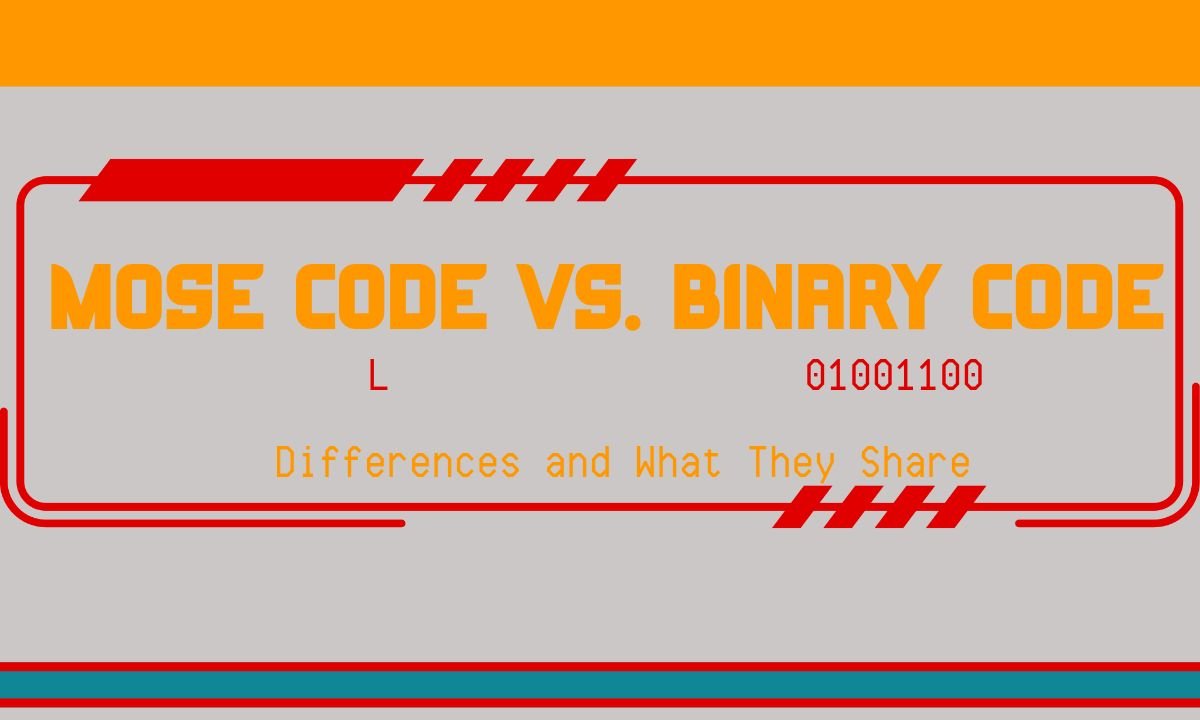
Quick takeaways Morse code vs binary code looks like an easy comparison: dots and dashes on one side, zeros and ones on the other. Then you try to read a string of dots with no spaces, and the easy answer falls apart. The same six dots can mean HI or six letter Es, so something … Read more
Quick takeaways Knowing how to use Morse code begins with one idea: every letter and number is a fixed pattern of short and long signals. A translator swaps your text for those patterns instantly. Morse CoDeCoder is an online Morse code translator for ham radio operators, students, puzzle fans, and educators. It converts text to … Read more
Key Takeaways Morse code is a way of writing text using only two signal lengths: short dots and long dashes. You can send those signals as sound, flashes of light, or electrical pulses, and the person receiving them turns the pattern back into letters. So what is Morse code in practice? It is the system … Read more
Key takeaways The telegraph and Morse code are two different things that worked as one system. Telegraph Morse code is the pairing of an electrical machine that sent signals along a wire with a dot-and-dash code that turned those signals into letters. At Morse CoDeCoder, an online Morse code translator and learning site for ham … Read more
Stay in Morse Code Learn how to write, copy, and play the word “Stay” in Morse code. Stay in Morse Code … – .- -.– Play “Stay” in Morse Code Stop Copy Morse Code Copied! Stay Letter-by-Letter Breakdown S … Tap to Play S T – Tap to Play T A .- Tap to Play … Read more