
Quick takeaways
- The main current uses of Morse code are aviation beacon identification, amateur radio, emergency signalling and assistive typing.
- Ships stopped relying on Morse for distress calls when GMDSS became mandatory in 1999.
- You can send it with sound, light, tapping or even blinking, which is why it works when other tools fail.
- You can translate and decode it in seconds with an online translator.
The uses of Morse code have narrowed since the telegraph era, but they haven’t vanished. Morse CoDeCoder, an online Morse code translator and decoder, hears the same question from students, hobbyists and ham radio operators: does anyone still use dots and dashes for real work? Yes. Pilots use them to confirm navigation beacons, radio amateurs use them to reach other continents with simple equipment, and people with limited mobility use them to type.
This guide covers eight current uses, backed by sources such as the FAA, the U.S. National Archives and Google. It also shows where Morse code has been replaced, so you don’t repeat outdated claims. By the end, you’ll know what Morse code is used for today and how to start using it yourself.
What Is Morse Code Used for Today?
Today, Morse code is used to identify aviation navigation beacons, to communicate over amateur radio, to send emergency signals and to help people with disabilities type. It’s also a hobby, a teaching tool and a design element. It’s no longer a mainstream way to send messages, but it still works where voice, power or bandwidth are limited.
The system itself is simple. Each character in the Morse code alphabet is a pattern of short signals (dots) and long signals (dashes), and the most common letter, E, is just one dot. A dash lasts three times as long as a dot, the gap between letters equals three dots, and the gap between words equals seven dots. If you want the full mechanics, read our guide to how Morse code works.
Because the code needs only two states, on and off, you can send it with a radio key, a flashlight, a tap on a pipe or a blink of the eye. That flexibility explains almost every modern use on this list.
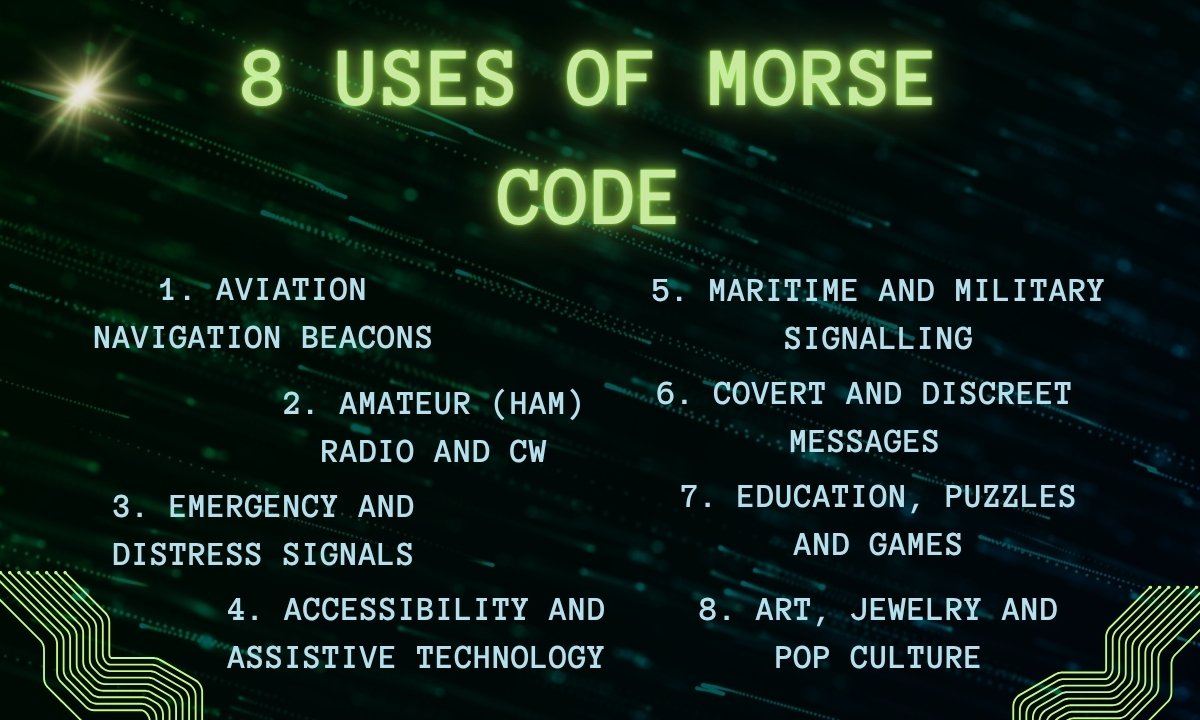
8 Uses of Morse Code in the Real World
1. Aviation Navigation Beacons
Pilots use Morse code to confirm that they’ve tuned the correct navigation aid. According to the FAA’s Aeronautical Information Manual, the only positive way to identify a VOR is by its Morse identifier or a recorded voice identification, and non-directional beacons (NDBs) transmit a continuous three-letter code except during voice announcements.
During maintenance, a facility may send the letters T, E, S, T as - · ··· -, or drop the code entirely, which signals that the aid is under maintenance. Some receivers decode the identifier and display it, while others leave the pilot to listen for it. Either way, the Morse signal is the check.
2. Amateur (Ham) Radio and CW
Amateur radio is where Morse code is most visibly alive. Operators call it CW, short for continuous wave, because the transmitter is switched on and off to form dots and dashes. CW signals are narrow and need only simple equipment, and they’re often readable in weak conditions where a voice signal turns to noise.
The FCC dropped the Morse requirement for all US amateur licenses on February 23, 2007, yet the ARRL reported that US licensee totals kept growing afterward, with a net gain of nearly 87,000 over the decade to 2016. Hams still run CW contests, join CW clubs and take courses such as CW Academy.
If you hear unfamiliar variants, our overview of the different types of Morse code explains why International Morse dominates the air, while American Morse, once called railroad code, survives mostly in historical re-enactments.
3. Emergency and Distress Signals
SOS is the most recognized Morse signal, and it works anywhere you can make short and long signals. It’s sent as three dots, three dashes and three dots, written ··· --- ···, and it’s run together as one pattern rather than three separate letters.
A phone flashlight, a whistle or a hammer on a pipe can all carry it. That makes it a useful backup when voice calls aren’t possible, such as during a power outage or inside a collapsed structure. If you can reach emergency services by phone, do that first, and treat Morse as the fallback that someone still has to notice.
4. Accessibility and Assistive Technology
Morse code is an input method for people who can’t comfortably use a standard keyboard. In 2018, Google added Morse input to Gboard, working closely with assistive-technology expert Tania Finlayson, who has communicated in Morse code since the 1980s and designed and co-developed the TandemMaster, as Google’s accessibility announcement explains.
The appeal is the small input vocabulary. With only two signals plus timing, the code can be adapted to a single switch or a small, reliable movement, which suits users who can’t operate a full keyboard. For these users, Morse code is a daily communication tool, not a curiosity.
5. Maritime and Military Signalling
Ships no longer depend on Morse code for distress calls, but light signalling and training persist in some fleets. Ships relied on Morse for distress and safety traffic from the late 1800s, and Wikipedia’s GMDSS article notes that the Global Maritime Distress and Safety System, which ships had to fit by February 1, 1999, ended Morse communications for all but a few users, such as amateur radio operators.
That’s why older articles claiming ships mostly use Morse are out of date. The French Navy sent its final Morse message on January 31, 1997, but lamp signalling remains a radio-silent backup in some fleets, including the US Navy.
6. Covert and Discreet Messages
Morse code can carry a message silently, because you can blink, tap or nod it. The best-known example comes from May 2, 1966, when U.S. Navy Commander Jeremiah Denton, a prisoner of war in North Vietnam, was forced into a televised interview. While he spoke, he blinked the word T-O-R-T-U-R-E in Morse code.
According to the U.S. National Archives, his message was the first clear confirmation for U.S. intelligence that American POWs were being tortured. The story shows why Morse code still matters as a human-readable signal: no device was needed, only someone who could read it.
7. Education, Puzzles and Games
Morse code is a simple first lesson in encoding. It’s one of the earliest digital codes, since every character is built from two signal types, so teachers use it to explain binary-style thinking, pattern recognition and communication history.
Puzzle designers use it in escape rooms, scavenger hunts and geocaching clues. If you solve a puzzle by hand, a Morse code decoder lets you check your answer in seconds. Keep a Morse code chart nearby while you start, then drop it as the patterns stick.
8. Art, Jewelry and Pop Culture
Designers use Morse code because dots and dashes make a compact, wearable pattern. Bracelets, necklaces, tattoos and wall art often spell a name, a date or a short phrase, and authors and filmmakers use it as a plot clue or hidden message.
Before you engrave or print anything permanent, run the text through an online Morse converter and check the spacing. One misplaced gap can turn a word into something else.
Uses of Morse Code for Learners and Hobbyists
You can start using Morse code today by translating short words, then decoding them back until the patterns feel familiar. Here’s a simple routine:
- Learn the timing rules. A dash is three dots long, letters are separated by three dots of silence and words by seven.
- Translate your name. Translate text to Morse code with a Morse code translator, starting with your own name.
- Decode a short message by hand. Try to decode Morse code on paper first, then check yourself with the tool.
- Practice by sound as well as sight. Many learners find the rhythm easier to recall than the written chart.
Short daily sessions usually work better than one long weekly session. A few minutes a day is enough to start, whether you’re heading toward a ham radio club, a puzzle night or a gift project.
Morse Code Uses: Frequently Asked Questions
Is Morse code still used today?
Yes. Morse code is still used for aviation beacon identification, amateur radio, assistive typing and backup signalling, though it’s no longer a mainstream way to send messages.
It has been replaced in some areas. Ships moved to satellite-based distress alerts when GMDSS became mandatory in 1999, and the FCC stopped requiring Morse for amateur licenses in 2007. The uses that remain are the ones where its simplicity is an advantage.
Do ham radio operators still use Morse code?
Yes, many ham radio operators still use Morse code, which they call CW. A license no longer requires it, so operators choose it for its narrow signals, simple equipment and reliability in weak conditions.
You’ll find CW contests, clubs and training programs run by active communities. Some operators treat CW as the main appeal of the hobby, while others never use it.
Is Morse code hard to learn?
No, but it takes steady practice. You’re learning about 36 patterns, 26 letters and 10 digits, and the most common letters have the shortest codes, such as a single dot for E.
Most people get further by studying a few characters at a time and decoding real words early. A translator and decoder helps you check your work as you go, so mistakes don’t harden into habits.
Did Morse code ever save lives?
Yes. Morse distress calling was the basis of ship-to-shore emergency calls for nearly a century, and Wikipedia’s GMDSS article notes it saved thousands of lives. In 1966, a single Morse message blinked on camera also gave U.S. intelligence its first clear confirmation of how American prisoners were being treated.
Today, it remains a backup signal when other tools fail, which is why people still learn it.
Conclusion: The Uses of Morse Code Worth Knowing
The uses of Morse code today are narrower than they once were, but they’re real: aviation beacons, ham radio, emergency signalling and assistive typing. Whether you’re a student, a pilot, a hobbyist or a teacher, a few learned patterns give you a signal that works with sound, light or touch.
Ready to try it? Visit the Morse CoDeCoder homepage to translate text to Morse code or decode a message you’ve found. Which of these uses surprised you most?
1 thought on “Uses of Morse Code: 8 Real-World Ways It’s Still Used Today”